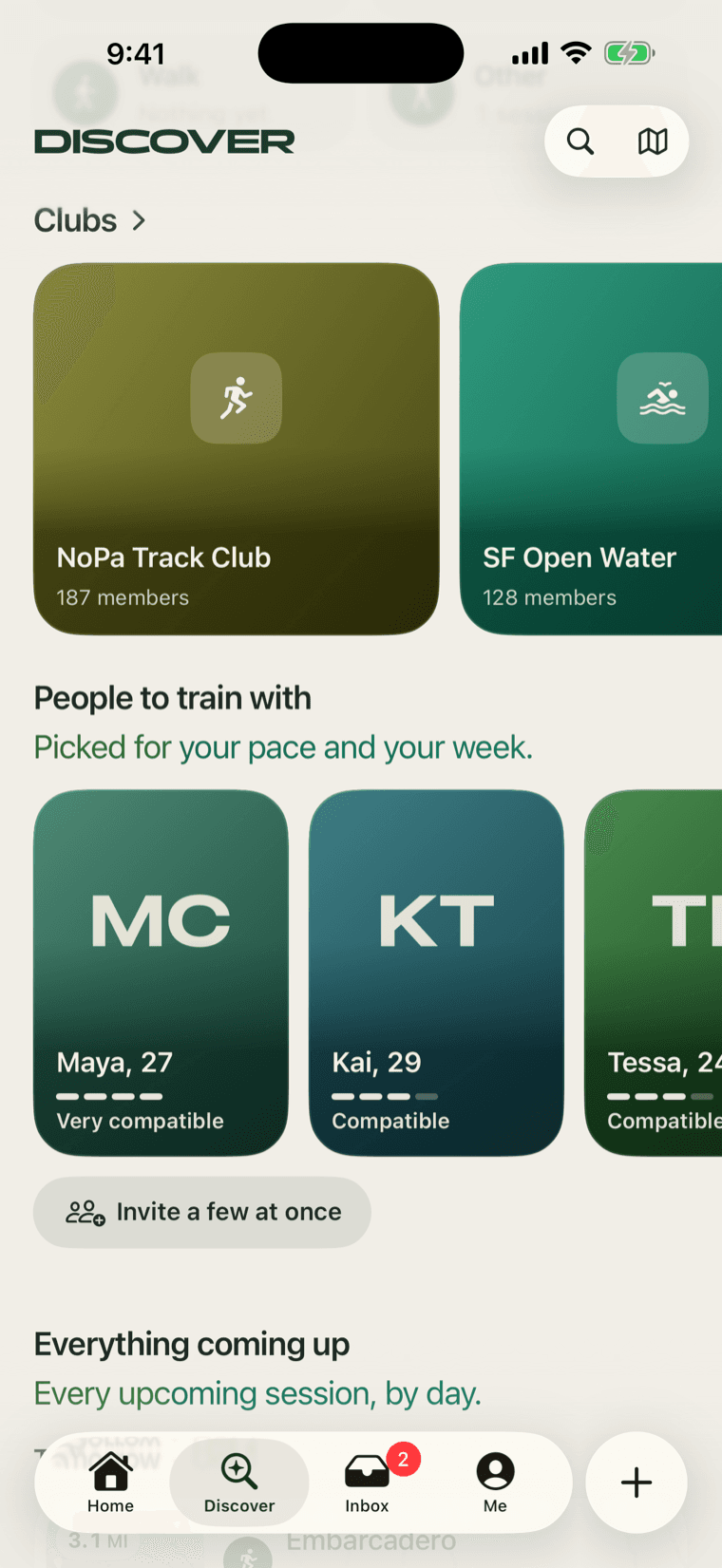
Every morning Mura puts up to five people in front of you under "People to train with". This post is the whole of how they are chosen, because we think you should be able to read it. It is the first version of the matcher, and the first version is meant to be simple enough to explain in a paragraph.
The pool
The candidates are people with a published profile who share at least one sport with you, are not private, are not blocked by you or blocking you, do not have an open invite with you in either direction, and have not been shown to you in the last two weeks. That last rule is what makes the list feel new each day instead of the same four faces in a different order.
What counts, and how much
Each candidate gets points for each thing you have in common.
| What you share | Points |
|---|---|
| Your pace ranges overlap for a shared sport | 3 |
| One of you has no pace on file yet | 1 |
| Same city | 2 |
| Same training cadence (how many times a week) | 1 |
| Same effort (easy, steady, hard) | 1 |
| A free window you both have | 1 |
| A club in common | 1 |
Pace carries the most weight because it is the thing that most often makes a session work or not. Two people who run ten minutes a mile apart can be friends; they cannot do a tempo run together. A missing pace gets a point rather than zero so that someone who skipped that step is not invisible.
The top five make the lineup. Ties go to the newer profile, so it gets its turn.
The reason, in your numbers
Each person in the lineup carries one line that says why they are there, and it is built from your own profile, not theirs: "Runs your pace (8:00-10:00 /mi) · in New York · both free Tuesday evenings". If you share a club, it says which one. The line is written at the same moment the points are counted, from the same facts, so it cannot drift from the truth.
A band, not a number
Six points and up reads as very compatible. Four and up, compatible. Two and up, somewhat. The card shows a four-segment meter and the band in words. It never shows the score.
We tried the number. A number invites an argument: why is she a 7 and he a 5? A band says what we actually know, which is roughly how much you have in common, and leaves the rest to the two of you.
When it runs
The lineup is made once per person per day, early, so it is waiting when you open the app in the morning. If for some reason it is not there yet, the app asks for it on open, and asking twice on the same day gives you the same five.
What we are watching
The weights are a starting point and we expect to change them. The signals we most want and do not yet have are how far someone is from where you actually train, rather than which city they live in, and whether you have trained together before, which the app will know once sessions have rosters that go back a few weeks. When those land, this post gets a sequel.
Until then, if your lineup is wrong, the fastest fix is the one you would expect: put your real pace in your profile. Everything above starts there.