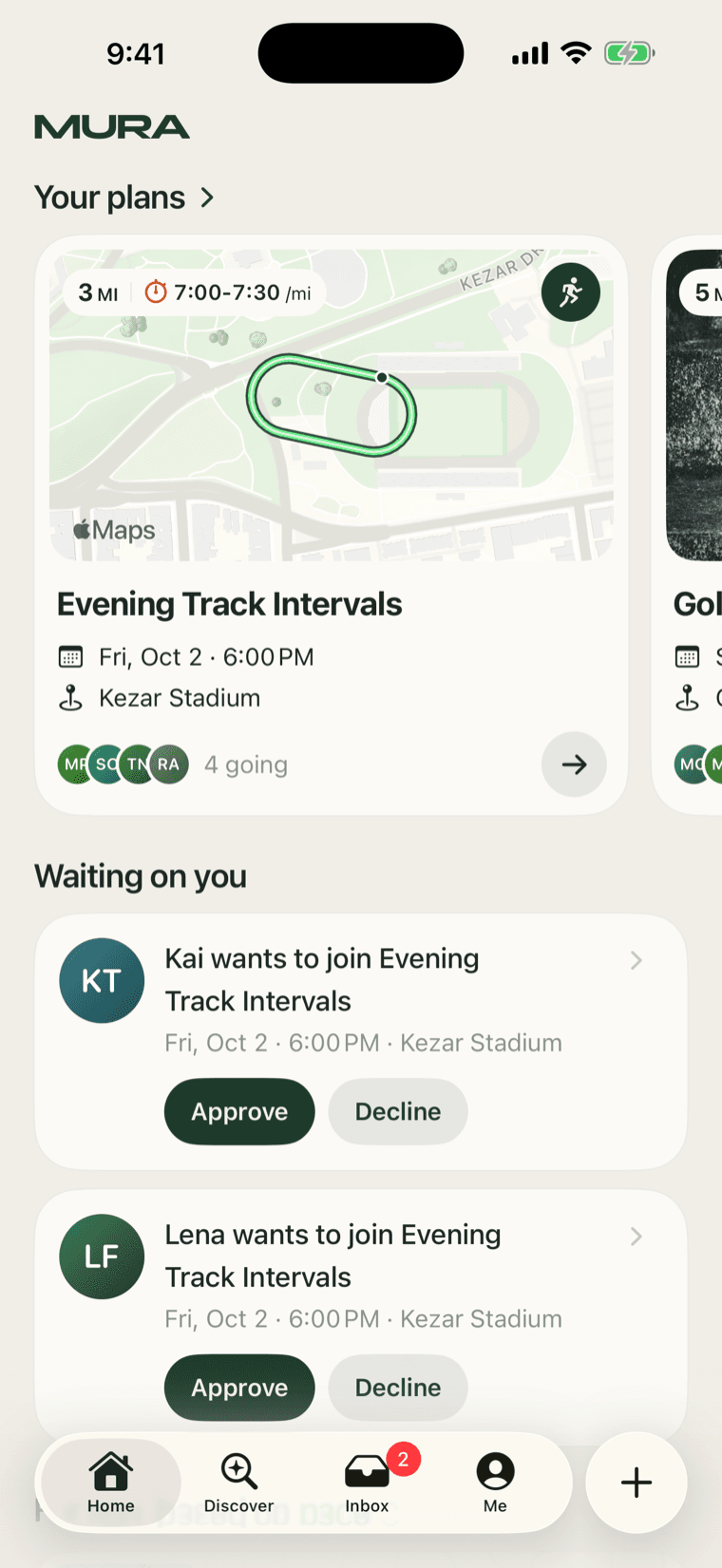
A week after launch we sat down and asked who Mura is for first. Not who uses it most, but who it should bend toward when two needs disagree. The answer was the person who runs the week: the club leader, or the host who posts the same Saturday session every Saturday. Members come because that person posted something and sent a link. If Mura makes that person's week easier, the members follow. This week's work on muramove.com is for them.
Start a club here
A club can now be started on the web, in the composer's shape: a name, what it is about, a city, a cover, and how people get in (open, by request, or by invite code). It is live the moment you finish, with its two channels, a general one and an announcements one, and a page at its own address.
One link to invite
Every club has an invite link, muramove.com/join and its code. Signed out, the page asks for an email and a code, as a session does, and then puts the person in the club. Signed in, it is one tap. It is the same link on a flyer, in a group chat, or in a bio, and it keeps working until a leader rotates it.
Members
The members page shows who is in and what they are, with requests at the top for leaders to answer. Leaders can remove a member; the club's creator can make and unmake admins. A public club's roster is open to anyone to read, because that is what public means; a private club's is for members.
Insights
This is the page we care about most, and the one we have tried hardest to keep honest. For a club's leaders it shows:
- Members, and how many joined in the last thirty days.
- Sessions coming up, and how many were held in the last ninety days.
- Twelve weeks of sessions, with how many said they were going and how many came.
- First-timers: people whose first session was in the last thirty days.
- Regulars: people who came to three of the last eight.
- Lapsing: people who last came between thirty and ninety days ago. These are the ones to message this week.
- People who joined and have never come.
- Pace fit: of the members with a pace on file, how many overlap the pace of your recent sessions. If that number is low, your sessions are faster or slower than your club.
"Came" means checked in, once a club has ever used check-in. Before that, it means said they were going, and the page says which it is using. We would rather show a smaller true number than a larger flattering one.
Check-in at the start line
Check-in is what turns "going" into "came". The host opens Manage, a code appears, members scan it or type it, or the host taps names. It takes a few seconds for a group of twenty and it is what makes every number above real.
Share, and the calendar
A story image and a square image for every session and for the week ahead, drawn from the club's own pages. A calendar feed for the club, so a member subscribes once and every session lands on their calendar from then on. A poster with the invite code for a noticeboard.
What is coming, and what is not for sale
Built and held back: notes a club sends on its own. A welcome a few hours after someone's first session, a nudge when someone is slipping and there is a session this week, a thank-you when someone becomes a regular, each in the leader's own words, each off until the leader turns it on. It is finished, and we are not switching it on until we have watched it run on a club we are in ourselves.
At the foot of Insights there is a quiet card that says Mura is free and asks whether you would pay for more of this. It is a question, not a gate. Nothing on the page is locked and nothing is going to be. We are asking because the honest answer shapes what we build next, and we would rather ask than guess.
If you run a club, start it here and send us a note with what the page should show that it does not. The people who run the week are the people we most want to hear from.